
How to Choose the Best Engine Heater
Aug 14, 2026
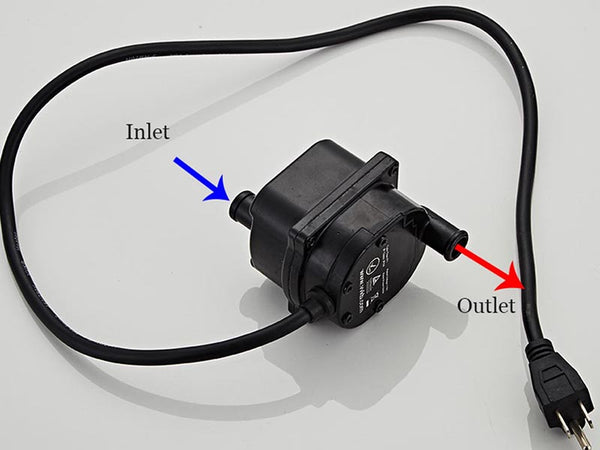
The best engine block heater for most drivers is a 1,000–1,500 W inline coolant heater with a built-in circulation pump, plumbed into a heater hose — not a freeze-plug heater. It heats the coolant, pumps it through the block, and it goes in without pulling a single engine part.
That answer holds for roughly nine out of ten vehicles, but the best engine heater for your situation still comes down to wattage, voltage and how long you can leave it plugged in. This guide walks the whole decision, including the electrical limit almost nobody mentions until your breaker trips.
Key takeaways
- Sizing rule: on a 110 V circuit the real choice is 1,000 W or 1,500 W. Go to 1,500 W above roughly 10 L of coolant, or if you park below -13°F (-25°C) — provided your circuit can carry it.
- The 15-amp ceiling: a 15 A household circuit is rated for 12 A / 1,440 W continuous. Run 1,000 W on a shared circuit; 1,500 W wants a dedicated 20 A circuit.
- Plug-in time: 30–60 minutes for an ATV or small car, 1–2 hours for an SUV or half-ton, 2–3 hours for a Class 6–8 truck or a big generator set.
- Running cost: a 1,000 W heater for 2 hours is 2 kWh — about $0.32 at $0.16/kWh.
- You do not need 195°F (90°C): oil starts flowing properly long before that. Every Vvkb unit cuts out at 149°F (65°C) and restarts at 113°F (45°C).
- Air-cooled engine? A block heater cannot help you. A silicone heating pad on the sump can.
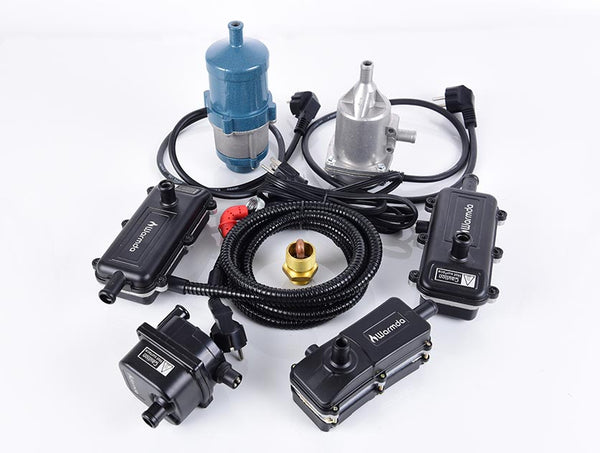
The short answer: which engine heater to buy, by vehicle
Match the wattage to how much coolant you have to heat, then check that your outlet can carry it. Everything else — brand, shape, mounting — is secondary to those two numbers.
| What you drive | Coolant volume | Wattage to look for | Vvkb model | Plug in for |
|---|---|---|---|---|
| ATV, UTV, snowmobile, small generator | 2–5 L | 1,000 W | Titan-P1 | 30–60 min |
| Compact car, or a small engine in extreme cold | 4–7 L | 1,200 W | Titan-B1 | 30–60 min |
| SUV, half-ton pickup, compact tractor | 8–15 L | 1,500 W | Titan-P3 | 1–2 hours |
| Heavy truck, Class 6–8, large generator set | 15–40 L | 1,500–2,500 W | Titan-P4 or Titan-P5 | 2–3 hours |
| Tight engine bay, or you want no pump to fail | Any | 500–1,500 W | Titan-P6 | Longer — no pump |
So what is the best engine block heater? The best block heater for car and light-truck owners on a household outlet is the one that puts the most heat into your coolant without overloading the circuit you plug it into — which in North America almost always means 1,000 W or 1,500 W. The best engine block heaters all share the same three traits: enough wattage for the coolant volume, a thermostat that regulates on coolant temperature rather than outside air, and an installation you can actually finish. Everything below explains how to land on your number and avoid the mistakes that generate most of the returns in this category.
What an engine heater does, in two sentences
An engine heater warms your coolant while the engine is off, so the first start of the day happens with oil that already flows. Most engine wear happens in the first few seconds of a cold start, before oil has reached the top of the engine.
That is the whole mechanism. If you want the physics in detail — heat transfer, where the heat goes, why the block warms unevenly — we wrote that up separately in how an engine block heater works. This guide is about choosing one.
Aftermarket auto block heaters: six families, and which ones earn their money
Six types of engine heaters are sold for cars and trucks, and only two of them warm the engine block itself. That distinction decides most of the buying decision.
| Type | What it heats | Install | Honest drawback |
|---|---|---|---|
| Freeze-plug block heater | Coolant, from inside the block | Knock out a core plug | The plug is often buried behind an exhaust manifold or a motor mount. If it fails later, you are back in there. |
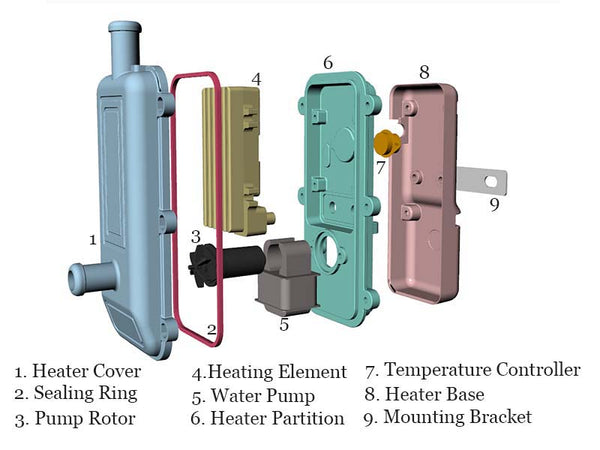
| Inline coolant heater with a pump | Coolant, circulated through the block | Cut a hose, fit two clamps | Needs a mains outlet, and the air has to be bled out properly. |
| Inline heater, no pump (thermosiphon) | Coolant, by natural convection | Cut a hose, fit two clamps | Slower than a pumped unit, and mounting height matters more. |
| Silicone oil pan heating pad | Engine oil only | Adhesive, on the sump | Does nothing for the block. On a diesel that is the half that matters most. |
| Magnetic heater | Whatever steel it sticks to | Stick it on | Low power, falls off, and will not stick to an aluminium sump. |
| Dipstick heater / heating blanket | Oil, or the air around the engine | Drop-in or wrap-on | Very little heat into the coolant. Fine at 23°F (-5°C), out of its depth well below that. |
The reason inline coolant heaters win for most people is access, not physics. On paper a freeze-plug heater is the more direct route — the element sits in the coolant jacket. In practice, owners on truck and tractor forums keep hitting the same wall: the core plug is hidden behind the exhaust manifold, or reachable only with the engine on a bench. An inline unit sidesteps all of it. You cut one hose, fit the heater, refill, bleed.
An engine coolant heater is sometimes sold as an antifreeze heater, and a coolant heater for a car may be listed under either name. They are the same device.

What size engine heater you need — and the 15-amp rule nobody mentions
Two numbers set your wattage: how much coolant you have to warm, and how much current your outlet can carry. The second one is the hard ceiling.
Step 1 — size it to your coolant volume
Look up your cooling system capacity in the owner's manual; it is usually printed in litres or quarts. For a car or light truck — call it 8 to 20 litres — allow roughly 100–150 W per litre. A 10 L system lands at 1,000–1,500 W, which is exactly where most passenger vehicles end up.
That per-litre figure stops working at both ends, and it is worth knowing why. Below about 8 L the answer is 1,000 W regardless, because nobody builds a useful 400 W coolant heater and a small loop warms quickly anyway. Above about 20 L the limit stops being the engine and becomes the outlet: a 30 L Class 8 truck would happily take 2,500 W, but on a 110 V household circuit you cannot give it more than 1,500 W. That is why heavy trucks in North America are usually preheated on 230 V, on a dedicated circuit, or with a longer plug-in time instead of more watts.
Within the range where it does apply, aim at the upper end if you park outdoors below -13°F (-25°C), if the engine is old, or if you want to be ready in under an hour. Aim lower if you have time and a garage.
Step 2 — check the circuit before you check the price
Current is watts divided by volts. A 1,000 W heater draws about 8.3–9.1 A, and a 1,500 W heater draws about 12.5–13.6 A, depending on whether your outlet is sitting nearer 120 V or 110 V.
Now the part that catches people. Under the US National Electrical Code, anything running three hours or more is a continuous load, and a breaker may only carry 80% of its rating continuously. So a 15 A circuit is good for 12 A, or 1,440 W — not the 1,800 W the label implies.
| Heater | Current at 120 V | On a shared 15 A circuit | Verdict |
|---|---|---|---|
| 500 W | 4.2 A | Plenty of headroom | Fine anywhere |
| 1,000 W | 8.3 A | Inside the 12 A limit | The safe default |
| 1,500 W | 12.5 A | Just over the 12 A limit | Dedicated 20 A circuit |
| 2,000–3,000 W | — | Not available on 110 V | 230 V only |
A 1,500 W unit on its own will not usually trip a healthy 15 A breaker — 12.5 A is inside the trip curve. It trips when something else is on the same circuit, when the breaker is twenty years old, or when it is fed through a thin extension cord. That last one is the most common of the three.
One mistake to avoid: a 16 or 18 AWG extension cord. For 1,500 W use the shortest 12 AWG cord that reaches, or run an outdoor GFCI outlet. Cheap cords do not usually trip the breaker — they just get warm at the plug, and stay warm for three hours every night.
This is also why 1,500 W is the practical ceiling on a North American 120 V / 15 A circuit, and why our 110 V models stop there while the 230 V versions go up to 3,000 W.
Diesel engines need more heater than gasoline engines
A diesel engine heater has to do more work than a gasoline one, because a diesel has no spark plug to fall back on. Compression ignition depends on the air in the cylinder getting hot enough on the compression stroke, and a cold iron block pulls that heat straight back out.
Three things stack up against you as a diesel owner in winter:
- Fuel gelling. Untreated diesel starts to gel somewhere around 15°F to 10°F (-9°C to -12°C). A coolant heater does not fix gelling — that is a fuel additive and a fuel filter heater job — but a warm engine bay helps everything downstream of the tank.
- Bigger blocks, more coolant. A 6.7 L pickup engine holds two to three times the coolant of a small gasoline car, so a diesel engine warmer needs more watts and more time for the same temperature rise.
- Higher compression, harder cranking. Cold, thick oil plus high compression is exactly the load your battery is worst at delivering in the cold.
In practice, a diesel engine heater for winter use on a pickup or a compact tractor means 1,500 W and 60–120 minutes. On a Class 6–8 truck or a large generator set, plan on 2,000–2,500 W and 2–3 hours. Diesel engine heaters sized below that will still help, they just take longer — and on the coldest mornings, longer is the thing you do not have.
Our engine heaters for diesels are the Titan-P3 (90° ports, for tight bays), the Titan-P4 (straight-through ports, for big trucks) and the Titan-P5 (heavy trucks, construction machinery, generator sets).

Starting in extreme cold: what a winter engine heater does and does not do
A car engine heater for cold weather buys you a start that is mechanically easier, not a warm cabin and not a fresh battery. Winter engine heaters get bought for one reason and judged by another, so it is worth separating the two up front.
Here is what actually happens. Transport Canada's testing found a block heater raises coolant temperature by roughly 36°F (20°C) in four hours. That sounds modest until you look at where the benefit comes from: you do not need the engine anywhere near operating temperature. Oil viscosity starts dropping the moment the coolant warms, and lubrication improves from the first few minutes of heating. By the time the coolant is at 86–122°F (30–50°C), most of the cold-start wear penalty is already gone.
That is why every Vvkb unit cuts out at 149°F (65°C) and restarts at 113°F (45°C), and why we do not offer a hotter version. There is nothing to gain above that point.
Block heater vs remote starter
They solve different problems, and a remote starter does nothing for the cold start itself. A remote starter fires the engine and idles it — which means the damaging cold start has already happened, and you are now burning fuel to make cabin heat. A pre-start engine heater warms the coolant before the key turns, so the start is gentler, but it will not defrost your windscreen.
In genuinely cold places most people end up running both: the engine heater on a timer for the mechanical side, the remote starter for the comfort side. If you can only have one and your concern is the engine, the heater is the one that protects it.
What a winter car engine heater will not do
Worth stating plainly, because these come up constantly:
- It will not warm your cabin. Car engine heaters, winter or not, warm coolant — not the interior. A winter car heater is a different product entirely: if you want a car heater for winter cabin warmth, the kind that blows hot air at the windscreen, that is a diesel air heater, not a coolant preheater.
- It will not charge or warm your battery. Cold cranking amps drop hard below 0°F (-18°C) regardless. A car winter heater makes the engine easier to turn, which asks less of the battery — but a dying battery still dies.
- It will not thaw gelled diesel in the tank or lines.
Within those limits, engine heaters for cold weather do the one job very well. A cold weather engine heater on a timer is the difference between an engine that turns over reluctantly and one that catches normally at -22°F (-30°C) — and that easier start, repeated every morning for four months, is what you are actually buying when you buy a car engine heater for winter.

What it costs to run an engine warmer
Multiply kilowatts by hours by your electricity rate. A 1,000 W engine warmer for two hours costs about $0.32 at $0.16 per kWh.
| Heater | 2 hours | 3 hours | A 90-day winter, 2 h/day |
|---|---|---|---|
| 1,000 W | $0.32 | $0.48 | about $29 |
| 1,500 W | $0.48 | $0.72 | about $43 |
| 2,500 W | $0.80 | $1.20 | about $72 |
At $0.16/kWh. Substitute your own rate — the arithmetic is kW × hours × rate.
For context: engine warmers for cars cost less to run across an entire winter than a single tank of fuel. Even the biggest engine warmers in the table stay under $75 for a 90-day season, and engine heaters for cars in the 1,000 W class come in under $30. As winter vehicle spending goes, a car engine warmer is close to the cheapest thing on the list.
The waste is not the heater, it is the hours. Owners who measure block temperatures consistently find the curve flattens: past about three hours the block is not getting meaningfully warmer, you are just paying to hold it there. Leaving it plugged in all night can quadruple the bill for no additional benefit.
Tip: a $15 outdoor timer or smart plug set to switch on two hours before you leave is the single best accessory you can buy with an engine heater. It also removes the temptation to leave it connected overnight, which we do not recommend.
Five buying mistakes that cause most of the returns
Almost every engine heater problem we see traces back to the purchase or the installation, not to the heater failing in service.
- Buying a freeze-plug heater without checking you can reach the plug. Look at the block first. If the core plug sits behind the exhaust manifold, buy an inline heater instead and save yourself the afternoon.
- Sizing to the vehicle instead of to the circuit. A 1,500 W heater on a shared 15 A garage circuit with a freezer on it will trip, and you will blame the heater.
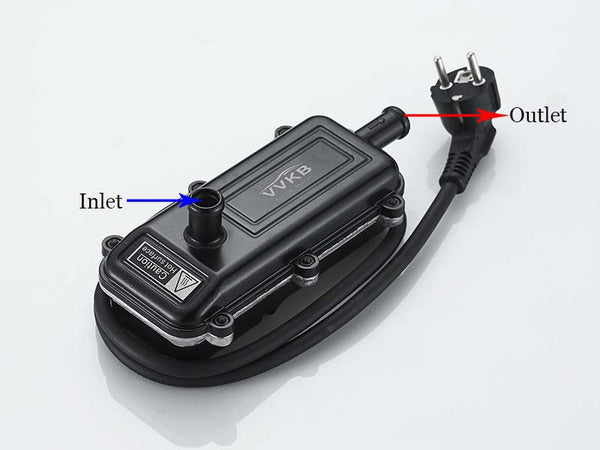
- Not bleeding the air out. This is the single biggest one. Trapped air means the heater body gets hot while the coolant stays cold, the pump runs intermittently, and in rare cases the unit is damaged. Fit the heater at the lowest point of the engine with the outlet facing upwards, and refill slowly until coolant flows from the outlet.
- Starting the engine while it is still plugged in. Never do this. Unplug first, every time.
- Filling with tap water. Minerals scale up the pump. Use distilled water in your coolant mix, and keep the heater body at least 4–6 inches (10–15 cm) from fuel lines.
The full sequence is in our engine block heater installation guide, and if you already have one fitted and are not sure it is doing anything, here is how to test it. Worth doing before winter regardless of brand — Ford alone has recalled around 179,000 vehicles over factory-fitted block heaters, per NHTSA records.
How Vvkb engine heaters compare
Vvkb has built engine heaters in China since 1996 — 30 years — and designed the first block heater with a built-in circulation pump in 1998. Six models are in production, and the differences between them are structural, not cosmetic.
| Model | Built for | Heating element | 110 V / 230 V | Pump & tees |
|---|---|---|---|---|
| Titan-P1 | ATV, snowmobile, small cars, small generators | Copper-plated tube | 1,000 / 1,500 W · 1,000 / 1,500 / 2,000 W | Pump, dual thermostats, no tees |
| Titan-B1 | Compact cars, larger displacement, extreme cold | Stainless tube die-cast into a solid aluminium block | 1,200 W · 1,200 W | Pump, dual ceramic thermostats, no tees |
| Titan-P3 | Trucks, pickups, tractors, diesel engines | Stainless tube die-cast into aluminium | 1,500 W · 1,500 / 2,000 / 2,500 W | Pump, dual ceramic thermostats, 2 tees, 90° ports |
| Titan-P4 | Large trucks, large generator sets | Stainless tube die-cast into aluminium | 1,000 / 1,500 W · 1,500 / 2,000 / 2,500 W | Pump, dual ceramic thermostats, 2 tees, straight ports |
| Titan-P5 | Heavy trucks, gensets, construction machinery | Copper-plated tube | 1,000 / 1,500 W · 1,500 / 2,000 / 3,000 W | Pump, dual ceramic thermostats, 2 tees |
| Titan-P6 | Any liquid-cooled engine, tight installs | Stainless steel tube | 500 / 1,000 / 1,500 W · same | No pump (thermosiphon), single thermostat, 2 tees |
Across the range: thermostats cut out at 149°F (65°C) and restart at 113°F (45°C); ports are 5/8 inch (16 mm) with 3/4 inch and 1 inch fittings selectable when you order; pumped models circulate 900 L/h; heating elements are rated for 8,000 hours and pumps for 5,000 hours.
The thermostat is inside the heater, not in the plug
Every Vvkb engine heater regulates itself from the coolant temperature at the element. A number of factory-fitted heaters instead use a thermostat built into the cord that only switches on below a set outside air temperature — which is why owners of those trucks end up cutting the sensor off and fitting a plain plug.
Ours cycles on coolant temperature, so it holds the engine ready instead of either running flat out or refusing to start. That is also why the heater switching off after half an hour is not a fault. It is the thermostat working.
Series or parallel, depending on engine size
Small engines get plumbed in series; large engines get plumbed in parallel through two tee fittings. On a small engine the whole coolant loop is modest, so running the heater in the loop warms everything in reasonable time — which is why the P1 and B1 ship without tees.
On a large diesel there is far too much coolant to bring up at once. The two tee fittings supplied with the P3, P4, P5 and P6 let you build a local loop that circulates only the coolant near the block, so a big engine reaches starting temperature much faster than it would in series.
Certifications, with the boundaries stated
The Titan-P1 to P5 and the Titan-B1 are listed on TÜV Rheinland EMC certificate AE 50378728 0001 and IEC 60335-1 safety report 50073775 001 (for the Titan-B1, report 50081208 001). Those documents cover the AC 230 V versions.
All six models — Titan-B1 and P1 through P6, at every voltage including 110 V — are listed on RoHS certificate POCE200512013DCR.
Tell us the model and voltage you are buying and we will send you the exact document we hold for it. That is worth asking of any supplier: approval paperwork that names the specific model you are being sold, rather than a general statement of compliance.
Frequently asked questions
What size engine heater do I need for my vehicle?
For a car or light truck, allow roughly 100–150 W per litre of coolant — so a 10 L system wants 1,000–1,500 W. Your cooling system capacity is in the owner's manual. The per-litre rule holds between about 8 and 20 litres; below that the answer is 1,000 W regardless, and above it the household circuit becomes the limit rather than the engine. If you are between sizes, go up if you park outdoors below -13°F (-25°C) and down if the vehicle sits in a garage. Then check the circuit — on a shared 15 A household circuit, 1,000 W is the practical maximum.
Will a 1,500 W engine heater trip my 15-amp breaker?
Usually not on its own, but it leaves almost no margin. A 1,500 W heater draws about 12.5 A at 120 V, which is inside a 15 A breaker's trip curve. The catch is that a 15 A circuit is only rated for 12 A continuous under the National Electrical Code, and anything running three hours or more counts as continuous. In practice the trips happen when something else shares the circuit, when the breaker is old, or when the heater is fed through a thin extension cord. Choose 1,000 W for a shared circuit, or put 1,500 W on a dedicated 20 A circuit with a short 12 AWG cord.
How long should I plug in an engine heater before starting?
30–60 minutes for an ATV, UTV or small car; 1–2 hours for an SUV or half-ton pickup; 2–3 hours for a Class 6–8 truck or a large industrial generator set. Past about three hours you are paying to hold a temperature you already reached. Use a timer rather than leaving it connected overnight — the thermostat makes that safe, but there is nothing to gain from it.
Is a dipstick heater or an oil pan heater enough in extreme cold?
Not below about 14°F (-10°C), and not on a diesel. A dipstick heater or a silicone pan pad warms the oil, which genuinely helps it flow — but it puts almost no heat into the block or the coolant. A diesel needs a warm block to fire on compression, so oil-only heating leaves the harder half of the problem untouched. If you are choosing between them at -4°F (-20°C), a coolant heater is the one that changes the outcome. Below freezing but mild, an oil heater alone is often enough on a gasoline engine.
My engine is air-cooled. What can I use?
Not a block heater — there is no coolant for it to heat. Air-cooled engines are common on smaller ATVs, youth models and older utility machines; if there is no radiator, it is air-cooled. The workable option is a silicone heating pad bonded to the outside of the sump, which warms the oil directly. It is lower powered and slower than a coolant heater, but it is the honest answer rather than "nothing can be done". Email us your engine and we will tell you what size pad fits.
My engine's thermostat is closed when cold. How does the coolant circulate?
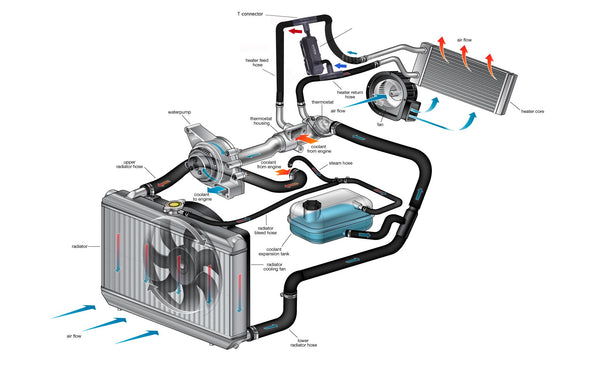
It circulates because the heater is not on the radiator circuit. Our heaters work on the engine's small circulation loop and do not run through the radiator, so the engine thermostat being closed has no effect at all on the heater's operation. This is also why the heater is plumbed into a heater hose rather than spliced into the top radiator hose.
Is it normal for the pump to make noise?
Some noise is normal, and one particular noise is not. Our pumps are magnetic drive — the rotor is a magnet spinning inside a plastic housing. When the heater is newly installed, coolant has not yet fully worked into the small gap between rotor and housing, and the pump can make a sharp, high-pitched sound. This normally fades within a few days.
A louder, rougher noise is different: that is the impeller rubbing the heater cover. Reinstall the heater, making sure the outlet faces upwards, and it clears up. If you hear the pump at all, that is also the easiest confirmation the unit is running.
Can I cut the upper radiator hose to fit it?
No — use a lower hose or a heater hose. The heater belongs at the lowest point of the engine with its outlet angled upwards, so that air bleeds out and warm coolant rises naturally into the block. Splicing into the top hose puts it at the high point, which is the one place trapped air will collect. On ATVs and UTVs the lower radiator hose is usually the right choice.
Does it restrict coolant flow when I am driving?
No. The pump only runs when the heater is plugged in. While you drive, the engine's own water pump pushes coolant through the heater, and the impeller is a centrifugal design that coolant passes straight between. The heater body and its 5/8 inch (16 mm) ports add slightly more restriction than a plain hose, but on a normal cooling system the effect is small.
Ready to pick your engine heater?
Vvkb has been building engine heaters in China since 1996, and we sell them direct rather than through a distribution chain. If you tell us the vehicle, the engine size and the voltage at your parking spot, we will tell you which model to buy — including telling you when the answer is a smaller one.
- ATV, UTV, snowmobile or a small car? → Titan-P1 or Titan-B1
- Pickup, tractor or diesel engine? → Titan-P3
- Heavy truck or generator set? → Titan-P4 or Titan-P5
- Tight engine bay, or you would rather have no pump? → Titan-P6
Not sure which one fits? Email info@rvheater.com with your vehicle and engine size and we will answer within 8 hours.
SEE ALL ENGINE BLOCK HEATERS →
Related guides
- How does an engine block heater work? — the heat transfer side, if you want to understand what is happening in the block.
- How to install an engine block heater — the full sequence, including bleeding the air out properly.
- How to tell if your block heater is working — three tests you can do before winter.
Written by Eric Zhang


