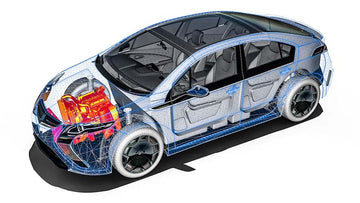
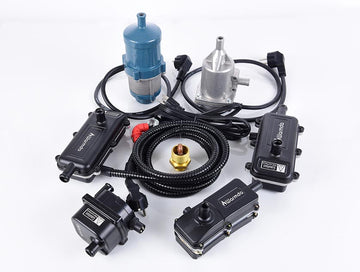
Inline Engine Coolant Heater with Pump — Titan-P4 for Large Trucks and Heavy Equipment
Only 9 in stock
If you've got a semi truck, large diesel, or industrial generator that a tight 90° block heater can't fit cleanly into, the Titan-P4 is built for you. Its 180° straight-through ports let coolant flow inline through your entire engine — no choke points, no flow loss, and easier to install on long hose runs.
-
180° Straight-Through Inline Design — Inlet and outlet sit on opposite ends, so your coolant flows in a straight path through the heater. Less flow resistance, faster heat transfer, and easier to install on long hose runs in large engine bays.
-
Built-In Magnetic Pump — 900 L/Hr Flow — Coolant circulates through your entire engine block, not just one local spot. Every cylinder warms up evenly, so the wear that happens in the first 30 seconds of a cold start drops the moment you turn the key.
-
1000W–1500W on 110V / 1000W–2500W on 230V — A standard 110V outlet safely handles up to 1500W (15A circuit). For 2000W or 2500W you need 230V — sized for semi trucks, large diesels, and big generators where a smaller unit would barely move the needle.
-
Dual Ceramic Thermostats for Safe Auto Cycling — Your heater kicks on at 113°F (45°C) and shuts off at 149°F (65°C). Two thermostats wired in series — if one ever fails, the second still stops the heater from overheating.
-
CE & TÜV Certified by German Labs — Both certifications come from independent testing, not a self-declared sticker. You're buying from a manufacturer with 30 years of experience and 10+ EU patents.
Which Engines Need the Titan-P4
The Titan-P4 is built for vehicles where the coolant hose runs in a straight line through a roomy engine bay. If your hose loops tightly around a compact engine, the Titan-P3 engine block heater with 90° ports is the better fit. The Titan-P4 shines on:
-
Semi trucks and Class 8 rigs — Freightliner, Kenworth, Peterbilt, Volvo, Mack. Big inline-6 diesels like the Cummins X15, Detroit DD15, and PACCAR MX-13 need 2000W–2500W and have plenty of hose room for a straight inline heater.
-
Heavy-duty pickups and medium-duty trucks — Ford F-450/F-550, Ram 5500, GMC 5500. Larger engine bays handle 1500W–2000W on a clean inline run.
-
Industrial diesel generators (20kW and up) — Cummins, Caterpillar, John Deere, and Kohler standby gensets. Inline flow keeps coolant moving evenly through the block before every cold start.
-
Agricultural equipment — Large tractors, combines, and harvesters with 4L–8L diesels and long stretches of coolant hose.
-
Marine inboard diesels (shore power required) — Commercial fishing boats, workboats, and large yachts that dock with 110V or 230V shore power.
Not sure if the P4 fits your setup? Compare all engine block heaters side-by-side.
180° Straight-Through Ports — Built for Large Engines
The 180° design isn't just a port configuration — it's a flow path. Coolant enters one end of the heater body, flows in a perfectly straight line through the heating element, and exits the opposite end. That single design choice is what separates the P4 from compact 90° models and why it works on big engines.
Lower flow resistance for big engines
A 90° elbow inside a heater creates turbulence and pressure drop. On a 1.5L car engine that's fine, but on a 15L Cummins or a 20kW genset, every flow restriction adds up. The P4's straight path lets the built-in 900 L/Hr pump push coolant through your entire engine block without fighting an internal bend.
Easier installation on long hose runs
Large engine bays usually have long, straight stretches of coolant hose. With the P4, you cut once, clamp twice, and the heater drops in line. No 90° fittings, no awkward rerouting — the heater sits flush with the natural path of your existing hose.
Even heating with no hot spots
Coolant moving in a straight line through the heating element gets uniform contact with the heat source. No dead corners where flow stalls and coolant overheats. The 149°F (65°C) shutoff stays accurate, the pump cycles cleanly, and heat exchange stays consistent run after run.
Built-in Pump Circulates Coolant Through Your Whole Engine
Cheap engine block heaters skip the pump and rely on thermosiphon — hot coolant rises, cold coolant sinks by natural convection. That works on a small engine in a heated garage. On a 15L diesel sitting in a windswept yard at -20°F (-29°C), the thermosiphon stalls and you end up heating one corner of the block while the rest stays frozen.
The Titan-P4 fixes that with a magnetic pump that runs the entire time the heater is plugged in. Coolant doesn't sit — it moves.
900 L/Hr through your entire engine block
The internal magnetic pump pushes 900 liters per hour through your engine's coolant passages. Every cylinder sees warm coolant within minutes, and by the 30–60 minute mark the whole block is sitting at 113–149°F (45–65°C) — the temperature range that actually matters for cold-start protection.
Why 65°C is enough (and 90°C is overkill)
You don't need a 194°F (90°C) "race-spec" thermostat to protect your engine — 104–122°F (40–50°C) coolant already does the job. Most engine wear happens in the first 30 seconds of a cold start, before oil pressure builds and moving parts get proper lubrication. Warm coolant thins out the oil, pushes lubrication into bearings faster, and ends most of that wear before it starts. The P4's 149°F (65°C) ceiling sits well above the protection threshold.
Magnetic pump rated for 5,000 hours
The pump is rated for 5,000 hours of continuous operation — roughly a decade of typical winter use (3 hours a day, 5 months a year). It's not a wear part you replace every season
Specifications
| Spec | Value |
|---|---|
| Voltage | 110V or 230V |
| Power (110V) | 1000W or 1500W |
| Power (230V) | 1000W / 1500W / 2000W / 2500W |
| Frequency | 60Hz (110V) / 50Hz (230V) |
| Port Configuration | 180° straight-through inline |
| Port Diameter | 5/8" (16mm) standard; 3/4" or 1" adapters available |
| Pump Type | Magnetic, 5,000-hour rated life |
| Pump Flow Rate | 900 L/Hr |
| Thermostat | Dual ceramic, cycles 113°F–149°F (45°C–65°C) |
| Heating Tube | Stainless steel encased in aluminum die-casting |
| Tube Life | 8,000 hours rated |
| Weight | 2.6 lbs (1.2 kg) |
| Dimensions | 8.7" × 2.6" × 3.5" (222 × 65 × 90mm) |
| Waterproof Rating | IPX4 |
| Certifications | CE, TÜV, RoHS, and FCC |
| Warranty | 1 year |
The 5/8" (16mm) port is the standard fit for most truck, generator, and agricultural coolant hoses. If your engine uses 3/4" or 1" hose, select the matching adapter when you check out — adapters are sold separately, not included in the box.
Installation in 5 Steps
Inline installation is straightforward — most owners do it in under an hour. Watch the engine heater installation video for a visual walkthrough, then follow the steps below.
1. Choose your install location. Find a straight section of your lower coolant hose (the one feeding back into the engine), at the lowest point you can reach. Keep the heater at least 4–6 inches (10–15 cm) away from fuel lines and exhaust components.
2. Drain coolant to below the cut level. Catch the coolant in a clean container — you'll refill with the same fluid. No need to fully drain the system.
3. Cut the hose and clamp the heater inline. Make a single clean cut, position the heater with the outlet pointing up so trapped air can escape, then secure both ends with hose clamps. Snug, not crushed.
4. Refill coolant and bleed all air. Top off your coolant reservoir. Start the engine briefly with the radiator cap off — do not plug the heater in yet — and let any trapped air burp out. Top off again until the level holds steady.
5. Plug in and verify. Connect the power cord to a matching outlet (110V or 230V — never cross-feed). Within 30 seconds you should hear a faint hum from the magnetic pump. Within 30–60 minutes the heater cycles off at 149°F (65°C) and back on at 113°F (45°C) — that's normal operation.
What Not to Do
- Don't run the engine while the heater is plugged in. Running coolant flow combined with active heating creates air bubbles around the heating element and burns it out within hours.
- Don't use tap water as coolant. Mineral deposits build up inside the magnetic pump and shorten its life by years. Use distilled water in your coolant mix.
- Don't mismatch voltage. A 110V P4 plugged into 230V will fry instantly. A 230V P4 on 110V won't generate enough heat to make a difference.
For deeper installation troubleshooting, see Vvkb's engine heater installation and precaution guide.
Frequently Asked Questions
Will the Titan-P4 fit my Cummins X15, Detroit DD15, or PACCAR MX-13?
The Titan-P4 doesn't replace any specific OEM block heater — it installs inline on your existing coolant hose, so compatibility comes down to hose access, not engine model. Big inline-6 diesels (X15, DD15, MX-13, ISX) all have plenty of straight hose run between the engine and radiator, which is exactly what the 180° P4 needs. The standard 5/8" (16mm) ports match the most common truck hose diameter; if your engine uses 3/4" or 1" hose, select the matching adapter when you check out.
Should I order the 110V or 230V version?
Order 230V if you're hauling in Europe, Australia, or running off industrial 230V shore power, and 110V if you plug into a standard North American outlet at home, at a truck stop, or in a shop. The 110V version maxes out at 1500W because a 15-amp household circuit can't safely handle more. If you need 2000W or 2500W of heat for a big diesel, you need 230V — either a 230V shore power line or a 240V outlet on a dedicated 20A circuit.
How long should I plug in the heater before starting?
30 to 60 minutes is enough for most engines, even down to -20°F (-29°C). The internal thermostats cycle the heater between 113°F and 149°F (45°C and 65°C), so leaving it plugged longer doesn't add more heat — it just runs up your electricity bill. We don't recommend leaving it plugged in overnight unattended. Plug in 30–60 minutes before you plan to drive, then unplug once the engine fires. That's also when you get the maximum benefit — most engine wear happens in the first 30 seconds of a cold start, and warm coolant fixes that.
Is the Titan-P4 compatible with HOAT, OAT, or Dex-Cool coolant?
Yes. The heater body, magnetic pump, and seals handle every common coolant chemistry — IAT, HOAT, OAT, NOAT, and silicate-based extended-life formulas. Don't mix coolant types when you refill after installation — top off with whatever's already in your engine. The one fluid to avoid is straight tap water; mineral deposits will shorten pump life. Use distilled water in any coolant mixture you make at home.
How much does it cost to run?
A 1500W heater pulls 1.5 kWh per hour of active heating. At average U.S. residential electricity rates (~$0.16/kWh), that's about 24 cents per hour. Because the dual thermostats cycle the heater on and off, actual runtime is usually 30–40 minutes per hour once the coolant is warm — roughly $0.10–$0.15 per pre-heat session. A 2500W version on 230V runs about $0.20 per session.
How does the Titan-P4 compare to Hotstart, Phillips & Temro, or Zerostart?
The Titan-P4 is built to the same engineering standards as the major brands — CE & TÜV certified, 5,000-hour pump life, 8,000-hour heating element rating — at roughly a third of the price. The big advantage of Hotstart, Phillips & Temro, and Zerostart is their OEM dealer networks: if you run a 50-truck fleet that needs guaranteed parts in 48 hours anywhere in North America, those brands have the supply chain. For owner-operators and small fleets, the Titan-P4 hits the same performance at a fraction of the cost.
My pump runs but the heater isn't getting hot — what's wrong?
This is almost always trapped air around the heating element, not a defect. The fix:
- Unplug the heater.
- Park on level ground, or with the front of the vehicle slightly raised.
- Open the radiator cap and top off coolant.
- Start the engine (heater unplugged) and idle for 5 minutes with the cap off.
- Watch for air bubbles burping out. Top off as needed.
- Reinstall cap, plug the heater back in.
If the problem persists after bleeding, check the Vvkb installation troubleshooting guide or contact our support team.

Engine Block Heater Titan-P4 Introduction
Watch how the Titan-P4 installs inline on your coolant hose and pumps warm coolant through your entire engine block in 30–60 minutes. See the 180° straight-through design and built-in magnetic pump in action.

Where the Titan-P4 Installs in Your Cooling System
The Titan-P4 mounts inline on your lower coolant hose, between the engine block and the radiator. Cut the hose once, clamp the heater in series, and the built-in magnetic pump pulls coolant from the engine, heats it, and returns it through the same loop. The 180° straight-through design keeps flow direction unchanged from your existing setup — no rerouting needed.

Titan-P4 Dimensions
The Titan-P4 measures 8.7" × 2.6" × 3.5" (222 × 65 × 90 mm) with 5/8" (16mm) inlet and outlet ports on opposite ends. The straight-through layout means the heater takes up the same hose length as the section of pipe it replaces — no extra bends, no extra fittings, no awkward routing through tight engine bays.

What's Inside the Titan-P4
Nine functional components in a single sealed unit:
1. Aluminum heater cover
2. Sealing ring (IPX4 waterproof)
3. Magnetic pump rotor
4. Stainless steel heating element
5. Water pump assembly (900 L/Hr, 5,000-hour life)
6. Heater partition
7. Dual ceramic thermostats (113°F–149°F / 45°C–65°C)
8. Aluminum die-cast base
9. Steel mounting bracket
Every component is rated for industrial cold-start duty cycles, not light-duty automotive use.

180° Inlet and Outlet — Straight-Through Flow
Coolant enters one end of the heater body and exits the opposite end in a perfectly straight path. No 90° elbow to slow the flow, no internal turn for the pump to push against. Your existing hose runs through the heater the same way it would through a section of straight pipe — but now with 1000W to 2500W of inline heat behind it.