
How to Install a Diesel Heater on a Boat
Aug 18, 2026
A diesel heater boat installation is won or lost on three parts. Those are the exhaust lagging, the fuel line material, and how high the skin fitting sits above the waterline. The heater itself is close to plug and play. Everything that goes wrong on a boat goes wrong around it.
Installing a diesel heater in a boat is what this article walks through, on a real sailing boat rather than a workshop bench. We replaced a 20-year-old unit with a 2.5KW Vvkb Apollo diesel air heater, kept the existing 60 mm ducting, and took it up the West Coast of Scotland. Every photo below is the actual boat, with the heater installed exactly as described.
Key takeaways
- Exhaust lagging: two layers of tubular glass fibre sleeve plus one layer of exhaust bandage, anchored with stainless ties
- Skin fitting height: at least 12 inches (300 mm) above the waterline, angled up, with a swan neck
- Fuel line: automotive nylon pipe is not permitted in boats — we used 5 mm OD copper with flared ends
- Fuel pump angle: mounted at 15–30° nose-up so air bleeds through instead of collecting
- Glow plug draw: about 7 A sustained, peaking near 9 A in the cold, for 90–120 seconds
- CO alarm: fit one and check its expiry date — sealed combustion does not replace it
What arrives, and what the boat still needs
The kit covers the heater side of the job; the boat side is on you. Ours came with the heater, the controller, the full wiring harness, stainless exhaust pipe, the fuel tank standpipe, clamps, screws and a printed manual.
The boat-specific parts we had to source ourselves were exhaust lagging, extra stainless cable ties, a small independent fuel tank, and the copper fuel line with its flare fittings. Budget half a day just for shopping if you start on a Saturday.
Note on today's kit: the current Vvkb marine kit ships with 6.5 ft (2 m) of annealed copper fuel line included. This owner had to buy his own in 2019. A truck or RV kit still gives you nylon only, so if you are converting one of those, the copper is on your shopping list.
The setup below applies to any air heater of this type, including a Webasto or Eberspächer installation. The heater brand changes the controller and the price; it does not change the exhaust, the fuel line or the skin fitting rules.

We wanted more output than the old unit but had no appetite for re-cutting the interior. The 60 mm ducting already ran where we needed heat, so retaining it drove the whole layout. If your ducting is already in, plan the heater position around it before you drill anything.
Sizing note from Vvkb: the 2.5KW Apollo-MV1 suits boats under about 34 ft; the 5KW Apollo-MV2 is the answer from 40 ft up. Allow roughly one air outlet per kilowatt. The marine heater selection guide works through cabin volume and outlet placement in detail.
Exhaust: lag it before you think about anything else
The exhaust gets hot enough to burn you, your fenders, or anything else that touches it. On a boat there is no engine bay to hide it in, so it runs through spaces people reach into.
We used two layers of tubular glass fibre insulation plus one layer of exhaust insulation bandage. Anchor the lagging with stainless steel cable ties or monel rigging wire. Plastic ties will not survive next to that pipe.

Check the exhaust clamps are seated square and fully tight before you close the locker. A joint that leaks combustion gas inside the hull is the one failure mode on this whole job that can hurt someone.
Correction to the original version of this article. An earlier draft said a carbon monoxide sensor was unnecessary if you used heavy-duty exhaust clamps. That was wrong and we have removed it. Fit a CO alarm regardless of how good the clamps are.
Note on today's kit: the current Vvkb marine exhaust is single-wall spiral 304 stainless and no longer ships with a separate silencer — the spiral profile does the quietening. It is not a double-lagged insulated pipe. The hot section near the heater still needs lagging that you fit yourself.
The skin fitting: height above the waterline and the swan neck
Two rules decide whether your exhaust stays dry: at least 12 inches (300 mm) above the waterline, and a swan neck before the outlet. Water that gets past the fitting runs downhill into the heater.
On this boat the owner sourced an insulated twin-wall skin fitting and angled it upwards. Internally the exhaust hose is clamped and lagged so nobody can brush against it reaching into the locker.
Our own marine kit supplies a plain stainless steel skin fitting, which is a corrosion-resistant mechanical seal rather than a heat barrier. If you want a twin-wall fitting, buy it separately — do not assume it is in the box.

On a sailing boat, think about where that fitting sits when you are heeled. Owners who put it low on the quarter report it going under regularly, and a bung is the usual workaround. Higher is always the easier answer.
Exhaust routing and outlet location
For exhaust location the aft quarter or transom is the standard choice, and there is a social reason as well as a technical one. A side exhaust points your fumes and noise straight at whoever rafts up alongside on a cold night.
Keep the routing as short as the layout allows, with no low point where condensate can pool. Every extra bend is back pressure the burner has to work against.
- Drill a pilot hole first and offer the fitting up outside to check the angle
- Use a grinding-tooth hole cutter so the gelcoat does not craze
- Sealant on both faces of the seal and in the screw holes
- Keep the outlet well away from the combustion air intake
Fuel line: why the nylon pipe in the box is not allowed on a boat
Automotive nylon fuel pipe is not permitted in boats. It is the single item most likely to be flagged by a surveyor or an insurer, and it is what nearly every kit ships with.
We used 5 mm OD copper tube with swaged, flared ends for compliance, joined to the heater with a short flexible rubber section and stainless clamps. Copper is the first material named in the US metallic fuel line rules, and it is what the UK Boat Safety Scheme expects on inland waterways.
Our marine kit now includes 6.5 ft (2 m) of annealed copper for exactly this reason. Measure your run before you start, because a longer route means buying an extra length.

The alternative route is USCG or ABYC Type A1 fire-resistant hose — A1-15 if you can get it — or ISO 7840 in Europe. ABYC A-7 is the standard that covers boat heating systems specifically. Ask your surveyor which one they want to see before you buy anything.
Do not upsize the bore. These metering pumps are poor at suction. Going bigger than the supplied 2 mm internal bore causes priming problems, and soft flexible pipe can collapse under suction and stop the pump priming on each stroke. Hard-wall pipe, small bore.
Filter direction and bleeding
The filter arrow points toward the heater, not toward the tank. Fitting it backwards is the most common reason a fresh install refuses to light.
We fitted a small spin-on filter on the inlet, with fire-resistant fuel-grade rubber tubing between the filter and the tank. To bleed the system, run the priming cycle and watch the clear section of line until the bubbles stop — expect several minutes on a long run.

Fuel pump angle: 15–30° nose-up, on soft mounts
Mount the metering pump at 15–30° with the outlet end raised, so air bubbles bleed through instead of parking in the pump body. Flat-mounted pumps trap air and give you intermittent lockouts you will chase for weeks.
Ours sits in a sound-absorbing mounting, firmly attached, well above the horizontal. Orientation matters as much as angle: the outlet must be the high end, and the pump body must not sit at the lowest point of the fuel run. Keep it within about 6 ft (2 m) of the tank and 13 ft (4 m) of the heater.
The pump ticks. On a boat that tick transmits through the structure, and if it is in the locker next to your aft cabin you will hear it all night. Three fixes that owners actually report working:
- Soft rubber mounts under the pump, and under whatever the pump is bolted to
- A plywood box lined with sound-absorbing quilt, itself on soft mounts
- A coil in the copper line either side of the pump to isolate the pulse from the tank
Fuel supply: an independent tank beats a tee into the engine line
A dip tube in your main tank is the tidiest answer; teeing into the engine supply is the one insurers dislike. Our main tank had no accessible spare fitting, so we took a third route.

We fitted a small independent tank using a go-kart component, held in a simple glass fibre tray we made up. The tank lifts out into the cockpit for filling, which keeps diesel smell out of the accommodation entirely.
Fit a shut-off valve at the top of the fuel lift pipe. It costs almost nothing and it is the difference between a five-minute filter change and a siphon down your bilge.
Wiring and the controller
Run the harness in one piece if you possibly can. The supplied loom reached both the power supply and a controller in the aft cabin without extensions. That removed every joint from the circuit.

Feed the heater from the house bank through its own fuse, not off a shared accessory circuit. Start-up pulls the highest current of the whole cycle, and a sagging supply is the most common cause of a heater that cranks and quits.
First start-up: what normal actually looks like
A normal start is roughly two minutes of glow plug, then a slow ramp to full output. Knowing the shape of it tells you immediately whether a fault is real.
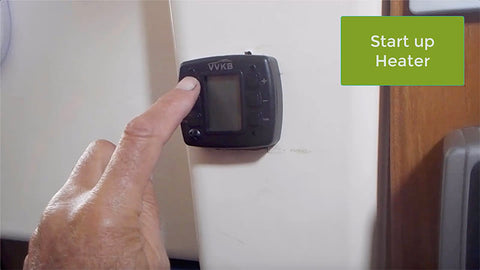
- Power on. The fan and the heater wake up together.
- Glow plug ramps up. We measured around 7 A held steady, briefly peaking near 9 A in genuinely cold conditions, sustained for 90–120 seconds depending on temperature.
- Glow plug backs off. Combustion carries itself, and air and fuel rise together.
- Ramp to full. The controller shows four bars at high output.

If yours ticks and draws current but never lights, that tick is just the pump working. Look at supply voltage during the glow phase first, then the filter direction, then air in the line — in that order.

Heat modes on a 2.5KW unit
You will live in Medium and Low; Boost exists for the first ten minutes of a cold day. Here is what each setting actually did on our boat.
| Mode | Output | What it is for |
|---|---|---|
| Boost | 2.5KW | Air comes out fast and spreads heat quickly. Only useful with a big temperature difference, and rarely for long. |
| High | ~2KW | The normal start-up mode. Brings the cabin up to temperature quickly on a cold morning. |
| Medium | 1,500W | Relaxed, steady heat. Current draw just under an amp. |
| Low | 1KW | Quiet and still genuinely warm. Where we spent most evenings. |
| Very low | Minimum tickover | Just enough to keep combustion safe. We do not use it — more ventilation, or switching off, are better answers. |

Why prolonged minimum output is worth avoiding: a burner that never runs hot for long enough cannot burn its own carbon off. That is the practical argument for matching heater size to boat size rather than buying the biggest unit available.
Carbon monoxide: what the alarm is and is not for
Fit a CO alarm near the heater, and check the expiry date on the one you already have. Sealed combustion means cabin air never touches the flame, but it does not cover a cracked joint or a fitting that loosens.
One warning about testing. Owners wave an alarm at the exhaust outlet, get no response, and conclude the alarm is faulty. It is not. CO alarms are deliberately slow. They respond to sustained exposure rather than a passing gust, and that behaviour is written into their own published specification.
If anyone aboard gets headaches, grogginess or nausea after a night with the heater running, treat it as exhaust exposure until proven otherwise. Run the heater in the evening and shut it down before sleeping while you investigate. There is more on venting clearances in our guide to whether diesel heaters are safe indoors.
How it performed: West Coast of Scotland
Our first week out ran a northerly airflow, daytime highs barely reaching 50°F (10°C) and nights close to freezing. The heater coped without complaint and made the boat properly comfortable to sit in.
Sailing in Scotland can be spectacular, and it is also frequently wet and cold. What we underrated was how much a heater does for damp. A warm boat is a dry boat, and dry bedding at the end of a wet day changes the whole trip.
Thanks to Mr. Whitehead for the photographs and the original write-up of this installation.
Frequently asked questions
How high above the waterline does the exhaust skin fitting need to be?
At least 12 inches (300 mm), and higher is better. Add a swan neck so that any water reaching the outlet cannot run down into the heater. On a sailing boat, check where the fitting sits when you are heeled hard on the relevant tack. Owners with low quarter fittings report them going under regularly, and carry a bung for that reason. A transom position is generally easier to keep clear than a topside one.
Can I use the nylon fuel line that came with the kit?
No. Automotive nylon fuel pipe is not permitted in boats, and it is the item most likely to be picked up by a surveyor or an insurer. Use 5 mm OD annealed copper with flared ends, or USCG/ABYC Type A1 fire-resistant hose (A1-15 if available), or ISO 7840 in Europe. UK inland waterway boats under the Boat Safety Scheme should assume copper. A short flexible rubber section at the pump connection is normal and accepted. Our marine kit includes 6.5 ft (2 m) of annealed copper; a truck or RV kit does not, so buy it before you start.
Do I still need a carbon monoxide alarm if the install is done properly?
Yes. Sealed combustion keeps cabin air away from the flame, which removes the largest risk. It does not cover a clamp that works loose or a joint that cracks with vibration. Fit an alarm near the heater and check its expiry date, because alarms have a service life and an expired unit is decoration. Do not judge an alarm by waving it at the exhaust — they are designed to respond to sustained exposure, not a brief gust.
Why does the fuel pump have to be mounted at an angle?
So air bleeds through it instead of collecting inside. Mount it at 15–30° with the outlet end raised. A flat-mounted pump traps bubbles, and trapped air produces intermittent ignition failures that look like a faulty heater. Keep it within about 6 ft (2 m) of the tank and 13 ft (4 m) of the heater. Put it on soft mounts too, because the ticking transmits through a hull far more than through a vehicle.
How hot does the skin fitting get?
Much cooler than the pipe at the heater end. The section closest to the heater is the hot one. Gas stream temperatures are commonly 390–570°F (200–300°C), with published figures around 536°F (280°C) measured 4 inches (100 mm) from the outlet. Owners measuring the far end with thermocouples report pipe wall temperatures nearer 120°F (50°C). That is why standard marine sealant around the fitting is normal practice, while the section near the heater needs proper lagging and clearance from anything that burns.
Which way does the fuel filter go?
Arrow toward the heater. The flow direction marked on the filter body points downstream, away from the tank. A backwards filter is one of the most common reasons a brand new installation will not light. It is a five-minute fix that people spend a whole weekend not finding. Check it before you strip anything else.
Can two heaters share one exhaust skin fitting?
No — fit a second through-hull. Joining two exhausts risks one heater's gases back-feeding into the other, and the back pressure when both run together can cause a lockout. Even where combustion air is drawn from outside, the shared path is the problem. A second fitting next to the first is cheaper than the troubleshooting.
Can I run the heater overnight at anchor?
Yes, that is the normal use case, with two conditions. The install must be sound and a CO alarm must be fitted and in date. Watch your house bank as well. Continuous running on a low setting draws around an amp on this unit, but start-up glow current is roughly seven times that. If anyone consistently feels unwell after an overnight run, stop using it overnight and find out why before you carry on.
Which heater for your boat
For cabin heat you want a diesel air heater, which is what this article covers. If you also want hot water at the tap, that is a coolant or hydronic unit — a different machine, and the two are not interchangeable.
Vvkb has been building diesel heaters in China since 1996. Our marine version swaps three parts that fail first on a boat. You get a stainless steel exhaust hull fitting, a stainless L-bracket instead of the mild steel floor mount, and 6.5 ft (2 m) of annealed copper fuel line in place of nylon. Certification details are on the Vvkb certifications page.
Under 34 ft? The 2.5KW Apollo-MV1 is the right size, and it will run near full output most of the winter.
40 ft and up, or a pilothouse with a lot of glass? Take the 5KW Apollo-MV2 and give it at least four outlets.
Not sure? Send your cabin dimensions and whether you need hot water to info@rvheater.com and you get a model and a KW figure back within 8 hours, not a catalogue.
Related guides
- Marine heater selection guide — works through cabin volume, outlet count and 2.5KW vs 5KW
- Are diesel heaters safe indoors? Venting, CO and safe use — the venting rules in full
- Diesel heater error codes and self-check — what the controller is telling you when it stops
Installation photographs and the original account by Mr. Whitehead. Reviewed and expanded by Vvkb, August 2026. Regulatory references: 33 CFR 183.538 (metallic fuel lines), ABYC A-7 (boat heating systems), ISO 7840 (fire-resistant fuel hose), UK Boat Safety Scheme.


2 comments
Thanks very useful article
Muchas gracias. ?Como puedo iniciar sesion?